Community Access Support Brisbane: One-to-One vs Group Support
Choosing the right community access support Brisbane option is not only about finding an activity. It is also about deciding what type of support environment helps the participant feel comfortable, involved and able to work towards their goals.
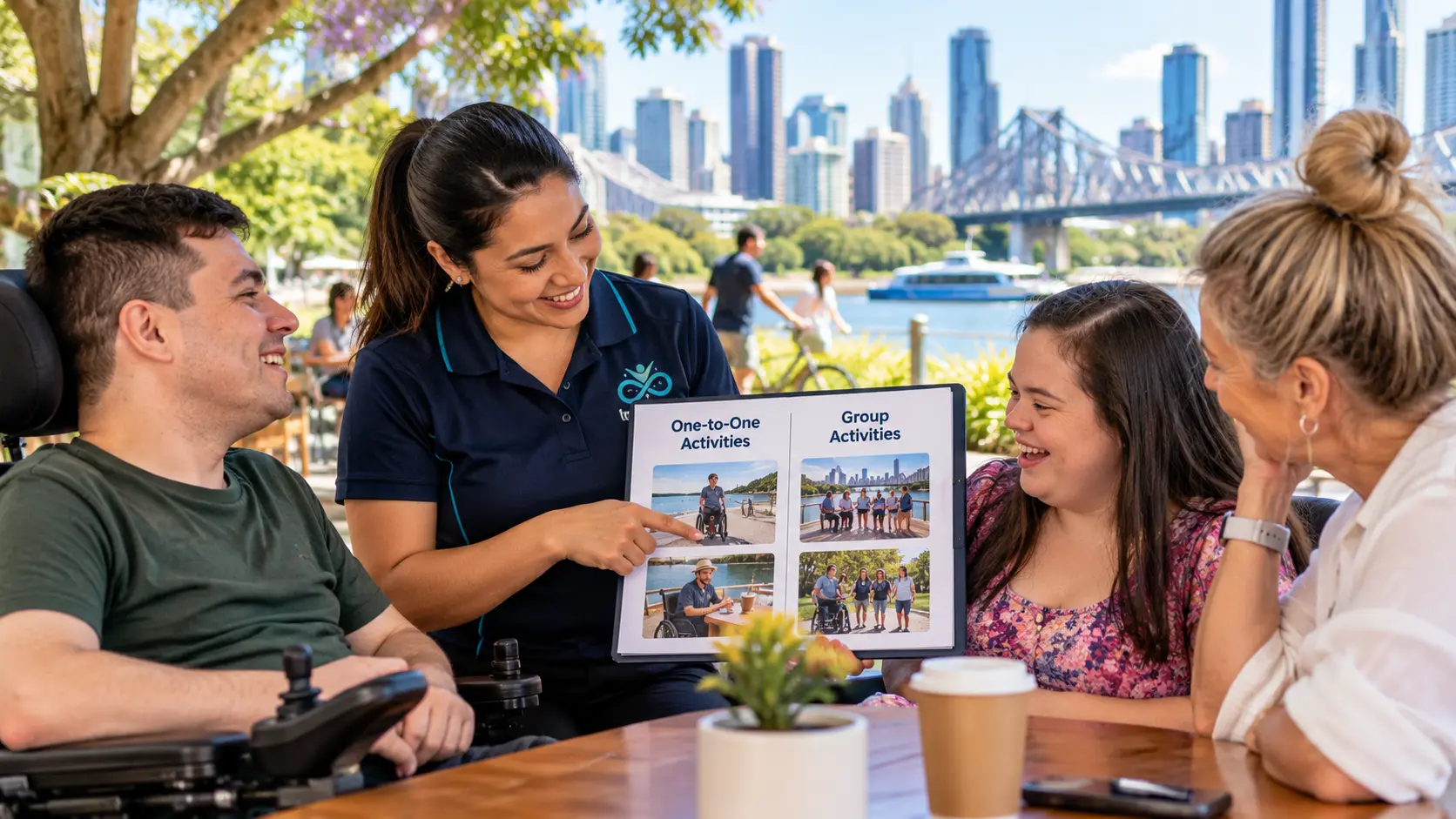
For some participants, one-to-one support offers the flexibility and individual attention they need. Others enjoy the shared experience of a group, where activities can create natural opportunities for social connection and participation.
Neither approach is automatically better.
The right fit depends on the participant’s interests, communication style, support needs, confidence, sensory preferences and NDIS goals.
This guide compares one-to-one and group community access support, explains when each may be useful and outlines what Brisbane participants and families should ask before choosing a provider.
What Does Community Access Support Brisbane Actually Mean?
Community access support Brisbane generally describes disability-related assistance that helps an NDIS participant take part in everyday community, social and recreational activities.
That might involve support to:
- attend a local activity
- go shopping
- visit a café
- participate in a hobby or class
- attend community events
- explore new interests
- practise everyday community skills
- build confidence in public places
- connect with other people.
The NDIS distinguishes the ordinary cost of an activity from disability-related support required to participate. Participants generally pay standard costs such as membership or entrance fees themselves, while eligible disability-related assistance may potentially be funded through the participant’s plan.
Community access should start with the participant
The starting point should not be:
Which activities does the provider already run?
A better starting point is:
What does the participant actually want to do?
From there, consider what assistance would make participation possible or more manageable.
Yirra Care’s NDIS Community Access in Brisbane service is built around participant interests, routines, goals and support needs rather than treating community access as simply attending scheduled activities.
Want to discuss community support built around your interests?
Discuss Community Access Support
What Is One-to-One Community Access Support?
One-to-one community access means one support worker is focused on supporting one participant during the agreed session.
This can provide more flexibility around:
- activity choice
- timing
- pace
- communication
- sensory needs
- mobility requirements
- transitions
- individual goals.
What can one-to-one support look like?
A session might involve:
- visiting a local café
- practising grocery shopping
- attending a hobby or class
- visiting a library
- learning a public transport route
- attending a community event
- exploring a new activity
- working towards greater confidence in unfamiliar places.
The activity itself is not always the main objective.
For example, grocery shopping may also provide an opportunity to practise planning, communication, decision-making or navigating a busy environment.
When may one-to-one community access support suit someone?
One-to-one support may be worth considering when a participant:
- wants highly personalised activities
- prefers quieter environments
- needs more individual assistance
- benefits from a predictable pace
- has specific communication needs
- becomes overwhelmed in larger groups
- wants to build confidence before trying group activities
- is working towards a very specific community-based goal.
GameSpec’s Brisbane community-access model, for example, positions individual support around the participant’s interests, preferred pace and confidence, including gradual preparation for broader community participation where appropriate.
That does not mean one-to-one support is only for participants who find groups difficult.
Some people simply prefer it.
What Is Group Community Access Support?
Group community support usually involves several participants joining a shared activity or outing with staff supporting the group.
Group activities might include:
- community outings
- cooking
- creative activities
- sport or recreation
- cafés
- gaming
- social events
- local attractions
- skill-building activities
- shared-interest groups.
The structure varies considerably between providers.
Some groups follow a fixed programme.
Others use smaller, flexible groups centred around shared interests.
Group support can create natural social opportunities
A group setting may provide opportunities to:
- meet other people
- practise communication
- share an experience
- discover common interests
- become familiar with regular participants
- participate in shared decision-making.
Marching Forward currently combines personalised one-to-one support with structured small-group programmes, showing how both models can sit within the same broader community-support approach.
24/7 Support Services similarly advertises both one-to-one and group participation support in Brisbane rather than presenting one format as appropriate for everyone.
Group support does not mean everyone needs the same thing
Even within a group, participants can have different:
- goals
- communication styles
- mobility requirements
- confidence levels
- sensory needs
- support requirements.
This is why group size and staffing arrangements matter.
Current NDIS provider record-keeping requirements state that group rosters should document the activity, participants, staff and the participant-to-staff ratio.
Before joining, ask what that ratio looks like in practice and whether it provides enough support for the participant.
One-to-One vs Group Community Access Support Brisbane
The differences become clearer when the two approaches are compared side by side.
| Consideration | One-to-One Support | Group Support |
|---|---|---|
| Worker attention | Dedicated to one participant | Shared across participants |
| Activity choice | Usually highly flexible | Often based around a shared activity |
| Pace | Can follow the participant’s pace | Must also consider the group |
| Social interaction | Can be introduced gradually | Naturally involves other participants |
| Sensory environment | Easier to tailor | More people and variables may be present |
| Scheduling | Often more flexible | Usually follows scheduled sessions |
| Goals | Can focus closely on individual goals | Can support social and shared-participation goals |
| Support needs | Useful where more individual assistance is required | Suitability depends on available staffing and group structure |
| Activity planning | Participant may have greater control | Activities may be planned for the group |
| Pricing | Depends on current support arrangements | Depends on the group model, current pricing and participant plan |
This is not a scoring table.
It is a decision tool.
How Do You Know Which Community Support Format May Fit?
Start with the participant’s real life rather than the service catalogue.
Choose based on interests
Ask:
- What does the person genuinely enjoy?
- Where do they already feel comfortable?
- What would they like to try?
- Are they interested in meeting other people?
- Do they prefer structured or spontaneous activities?
A participant who loves art may enjoy a small creative group.
Someone who enjoys photography may prefer one-to-one outings around Brisbane while building confidence using their camera in public places.
Interest gives the support a purpose.
Consider communication
A group can provide natural communication opportunities.
However, it can also mean less individual time with a worker.
Ask whether the participant needs:
- communication prompts
- AAC support
- additional processing time
- help understanding instructions
- support communicating choices
- assistance navigating social situations.
The answer may influence group size or whether individual support is more appropriate initially.
Consider sensory preferences
Noise, movement, crowds, lighting and unpredictability can significantly affect whether an activity feels manageable.
One-to-one support may allow easier adjustment of the environment.
A smaller structured group may also work well where the environment has been planned appropriately.
GameSpec’s Brisbane model, for instance, emphasises sensory-considerate environments and gradual participation for participants who may find traditional community settings overwhelming.
Think about flexibility
One-to-one support usually makes changing plans easier.
If a venue is too busy, the participant and worker may be able to choose somewhere else.
Groups are generally less flexible because several people’s plans need to be considered.
That structure is not necessarily negative.
Some participants prefer knowing:
- exactly where they are going
- who will be there
- when the session starts
- when it ends
- what activity is planned.
The best option depends on the individual.
Can a Participant Use Both One-to-One and Group Support?
Yes, these approaches do not have to be mutually exclusive.
For some participants, combining them may make sense.
One-to-one support before a group
A participant might begin individually to:
- become familiar with a venue
- build confidence travelling there
- practise communication
- understand what will happen
- meet a support worker
- explore interests.
Later, they may decide to join a small group.
Group support with occasional one-to-one sessions
Another participant may regularly enjoy group activities but use individual support for specific goals.
For example:
Group: weekly social activity.
One-to-one: learning a new transport route.
The right mix depends on the participant’s plan, funding, goals and support requirements.
Community access should not become a rigid pathway where someone must “graduate” from one type of support to another.
Participant preference remains important.
For broader information about what community participation can involve, see Yirra Care’s NDIS community participation guide.
Connecting Community Access Support to NDIS Goals
A support session should ideally have a reason behind it.
That does not mean every outing needs to feel like a formal training exercise.
The connection can be simple.
Goal: become more confident in the community
One-to-one support could involve:
- visiting new locations gradually
- ordering at a café
- asking staff for information
- navigating unfamiliar spaces.
A group option could involve:
- regular shared outings
- becoming familiar with peers
- attending local events
- practising participation in busier environments.
Goal: build social connections
A group may create more opportunities to meet people with shared interests.
One-to-one support can still contribute by helping the participant:
- explore suitable groups
- prepare before attending
- practise communication
- build confidence approaching new situations.
Goal: increase independence
Support might focus on:
- planning an outing
- managing time
- making choices
- purchasing items
- learning routes
- solving simple problems in the community.
The support model should follow the goal rather than the other way around.
Yirra Care’s existing guide to social activities for people with disabilities in Brisbane provides activity ideas and explains why some participants may benefit from starting with individual support before moving into a group setting.
Have community participation goals but are unsure which support format fits?
Talk to Yirra Care About Community Access
What Does the NDIS Fund for Community Participation?
This is an area where participants and families should separate support costs from ordinary activity costs.
Current NDIS guidance explains that participants generally pay the costs everyone else would pay for an activity, such as:
- entrance fees
- memberships
- registration
- ordinary equipment.
The NDIS may potentially fund eligible disability-related assistance needed to participate.
For example:
A participant attends a pottery class.
The ordinary class fee may be their personal expense.
If the participant requires disability-related assistance from a support worker to participate, that support may potentially be funded where it meets the applicable requirements.
This distinction applies whether support is individual or group-based.
Do not assume group support is automatically cheaper
A group setting can involve shared staffing, but the actual amount charged depends on:
- the support being delivered
- staffing arrangements
- applicable support items
- the participant’s plan
- current NDIS pricing rules.
The current 2026–27 NDIS pricing schedule took effect on 24 September 2026. Maximum prices under that schedule apply to NDIA-managed and plan-managed participants.
Ask the provider to explain the proposed charge before services begin.
Important NDIS Update From 1 October 2026
Because this article is being published on 1 October 2026, there is an important current change participants should know about.
The NDIA announced on 17 September 2026 that some budgets in the Social Economic and Community Participation category will be reduced progressively over the following 12 months.
The change applies as relevant plans are:
- created or reassessed from 1 October 2026
- renewed from 1 February 2027.
The NDIA states that the impact will be different for every participant because plans are based on individual goals, circumstances and support needs.
This does not mean every participant loses their community access support on 1 October.
Participants should check their current plan and seek current information when a new plan, reassessment or renewal occurs.
The broader legislation behind these reforms passed Parliament on 19 August 2026, with changes to social and community participation funding scheduled to phase in from October.
For that reason, avoid relying on older articles that quote fixed funding assumptions without checking current NDIS guidance.
What Should You Ask a Community Access Provider Brisbane?
The provider’s service page can tell you what they offer.
A conversation reveals whether the service actually fits.
1. Do you offer one-to-one, groups or both?
Ask what each option involves.
Do not assume “community access” means the same thing between providers.
2. How are activities chosen?
Ask whether activities are:
- participant-led
- chosen by the provider
- fixed on a calendar
- decided by the group
- planned around individual goals.
If participant choice matters, understand how much flexibility actually exists.
3. What is the group size and staffing ratio?
For group support, ask:
- How many participants usually attend?
- How many workers are present?
- What happens if someone needs additional help?
- Can the ratio change between activities?
This can materially affect the participant’s experience.
4. Can support be adjusted over time?
A participant’s confidence or needs may change.
Ask whether they can:
- begin one-to-one
- try a small group later
- return to individual support
- combine both approaches.
5. How are workers matched?
For ongoing one-to-one support, consistency may matter.
Ask about:
- shared interests
- communication style
- availability
- worker experience
- participant preferences.
6. What happens if the environment becomes overwhelming?
Ask how workers respond if a participant:
- wants to leave
- needs a break
- becomes uncomfortable
- changes their mind.
Support should respect communication and choice.
7. Which costs are separate?
Clarify:
- support-worker charges
- transport
- tickets
- meals
- activity fees
- equipment
- cancellations.
This avoids confusion later.
8. How does the service connect with NDIS goals?
Ask the provider how activities and support are documented.
Current NDIS provider guidance says case notes may describe activities and how they relate to the participant’s goals.
Red Flags When Choosing Community Access Support
Be cautious if a provider:
- insists every participant joins the same activities
- cannot explain group size or staffing
- cannot clearly explain pricing
- pushes a group when the participant is uncomfortable
- discourages individual choice
- ignores communication or sensory needs
- cannot explain how the support connects with participant goals
- is unclear about what activity costs are separate
- pressures the participant to commit immediately.
A community access provider should be able to explain what support will be delivered and how.
Current NDIS guidance also requires providers to tell participants the price of supports before delivering them and maintain accurate records of what has been provided.
Choosing Community Access Support Brisbane Based on the Person
The decision between one-to-one and group support does not need to be permanent.
Start with the participant.
Ask:
What do they enjoy?
What do they want to work towards?
How much individual support do they need?
Do they want to meet other people?
What environments feel comfortable?
Would a fixed routine help, or is flexibility more important?
Those answers tell you much more than simply choosing the provider with the longest list of activities.
Yirra Care’s community access service in Brisbane supports participants to discuss interests, routines, goals and support requirements before suitable community activities are planned.
Ready to explore one-to-one or group community support?
Start a Community Access Enquiry
FAQs About Community Access Support Brisbane
What is community access support Brisbane?
Community access support Brisbane refers to disability-related assistance that can help an NDIS participant take part in community, social, recreational or everyday activities where that support aligns with the participant’s needs and plan.
Is one-to-one community access better than group support?
Neither is automatically better. One-to-one support offers more individual attention and flexibility, while group support can create additional opportunities for shared activities and social connection. The right option depends on the participant.
Can I use one-to-one support before joining a group?
Potentially, yes. Some participants may prefer to build confidence individually before trying a group. Others may choose to remain with one-to-one support.
Can I use both one-to-one and group community support?
Potentially, depending on the participant’s plan, goals, funding and service arrangements. The two approaches can support different goals.
Does NDIS community participation Brisbane include social activities?
Social and recreational participation may form part of a participant’s community participation goals. Disability-related support may potentially be funded where it meets NDIS requirements, while ordinary activity costs generally remain the participant’s responsibility.
Are activity fees included in community access funding?
Not automatically. Current NDIS guidance says ordinary costs such as entrance, registration and membership fees are generally paid by the participant. Eligible disability-related support required to participate may be funded separately.
What should I ask before joining a community access group?
Ask about group size, participant-to-worker ratio, activity choice, accessibility, sensory environment, support level, pricing, transport and what happens if the participant needs additional assistance.
How do I find a community access provider Brisbane?
Compare providers based on the participant’s goals and support needs rather than activity lists alone. Ask whether they offer individual and/or group support, how activities are chosen and how the proposed support will fit the participant’s plan.
Finding the Right Balance Between Support and Participation
Good community access support Brisbane should create opportunities rather than pressure.
For some people, that starts with one support worker and a quiet local outing.
For someone else, a regular group activity may provide exactly the sense of connection they are looking for.
Others may use both.
The right approach is the one that reflects the participant’s goals, interests, preferences and support needs.
Start small if needed.
Review what works.
Change the approach when circumstances change.
And before services begin, confirm how support will be delivered, what it will cost and how it fits the participant’s current NDIS plan.