NDIS Personal Care Brisbane: In-Home Support Explained
NDIS personal care Brisbane support can help eligible participants with personal daily activities when disability affects how independently or safely they can manage their routine at home.
Personal care can involve very private parts of everyday life. Depending on the participant’s needs and approved supports, assistance may relate to personal hygiene, showering, dressing, grooming, toileting, getting ready for the day or moving through daily routines.
The level of help is different for every person.
Some participants may need hands-on assistance. Others may need supervision, prompts or help with only one part of a routine.
Current NDIS guidance explains that support workers may provide personal care such as general hygiene and dressing, with the amount of assistance depending on the participant’s needs and funding.
This guide explains what personal care can look like at home, how choice and privacy should shape support, what to discuss with a Brisbane provider and why personal care should never be treated as a standard checklist.
What Is NDIS Personal Care?
Personal care refers to support with personal daily activities that a participant may have difficulty completing because of disability.
The NDIS identifies self-care as an important area of everyday functioning. Examples include dressing, bathing, grooming, eating and toileting.
Within a support arrangement, personal care might involve assistance with parts of a morning or evening routine rather than support throughout the entire day.
The aim should be to provide the level of help the participant actually needs while respecting dignity, privacy, preferences and opportunities for independence.
How NDIS personal care Brisbane can fit into daily life
Imagine two participants.
One person may be able to shower independently but need assistance getting dressed and organising their morning routine.
Another participant may need more direct help with personal hygiene and mobility around the home.
The words “personal care” describe a broad area of support. They do not tell you exactly what assistance an individual person needs.
That needs to be discussed.
For participants looking for broader practical support at home, Yirra Care’s NDIS in-home support Brisbane page explains how daily routines, comfort and independence can form part of an individual support conversation.
Looking for respectful support with personal routines at home?
Discuss In-Home Personal Support
What Can NDIS Personal Care Brisbane Include?
NDIS personal care Brisbane may involve different personal daily activities depending on the participant’s disability-related needs, approved plan and service arrangement.
Examples can include support with the following areas.
Personal hygiene and showering
A participant may require support preparing for or completing a shower or bath.
That might include:
- preparing clothing and personal items
- assistance entering or leaving the shower where appropriate
- support with washing
- prompts to follow a familiar routine
- helping the participant organise the bathroom afterwards.
Privacy matters particularly strongly during this type of support.
The NDIS Code of Conduct requires workers and providers to respect participants’ privacy, self-determination and decision-making and to provide services safely and competently.
The NDIS Commission specifically notes that privacy includes how personal support is delivered, including respecting boundaries during dressing, showering and other activities involving personal space.
Dressing and getting ready
Support with dressing might involve:
- choosing appropriate clothes
- organising clothing in advance
- assistance putting clothes on or taking them off
- managing fastenings
- preparing for work, appointments or community activities.
Good support should not assume the worker chooses what the participant wears.
The participant’s preferences remain central.
Grooming
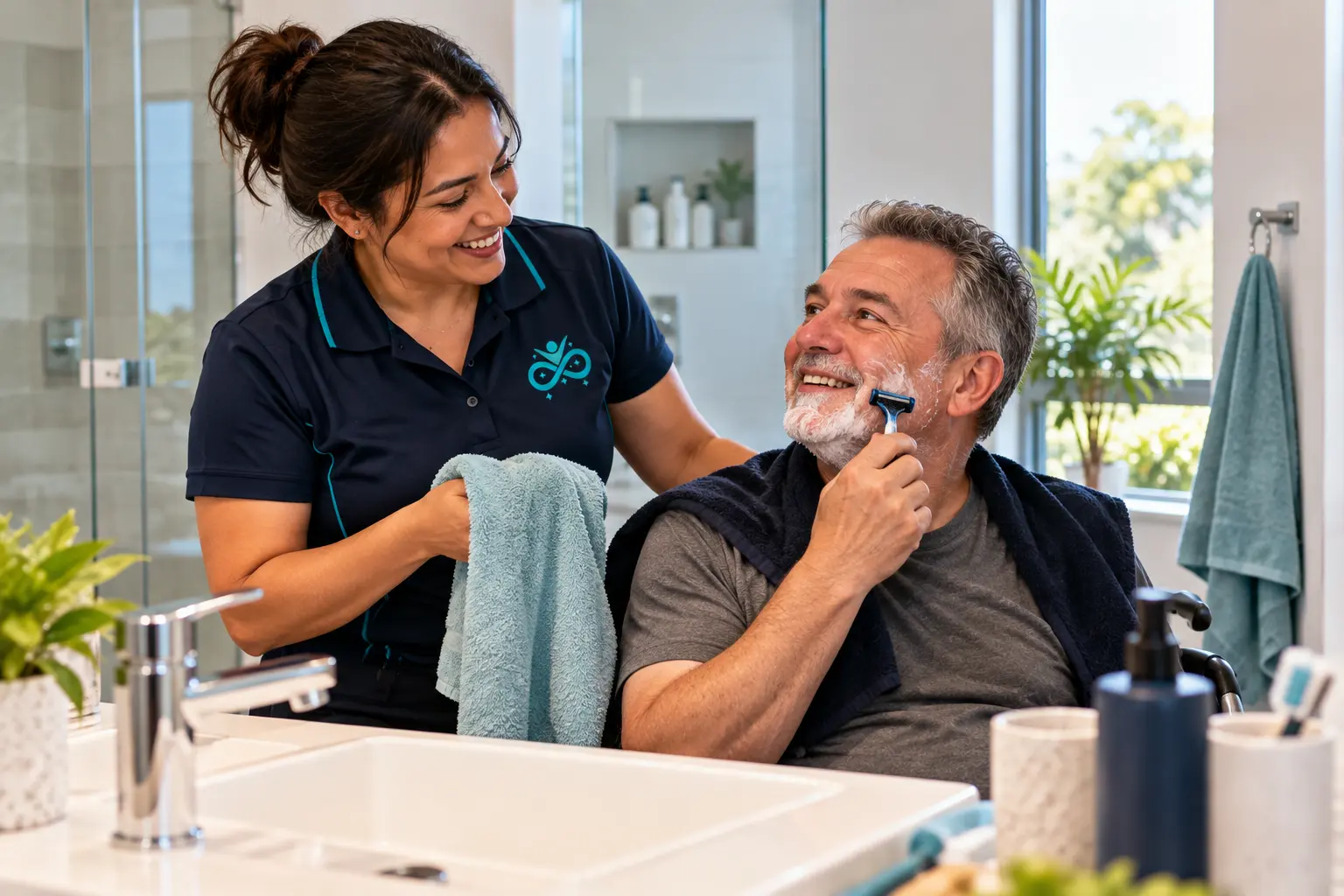
Grooming routines may include support with activities such as:
- hair care
- shaving
- oral hygiene
- basic skin-care routines
- preparing for the day.
Some participants may need physical assistance.
Others may mainly benefit from prompts, organisation or extra time.
Toileting routines
Toileting is another recognised area of self-care under NDIS functional guidance.
Because this is particularly private support, arrangements should be discussed clearly before services begin.
The participant should understand:
- what assistance will be provided
- who will provide it
- how privacy will be maintained
- what preferences or routines should be followed.
Mobility within a personal routine
Some participants may require assistance moving through their daily routine.
This might involve support getting ready, moving between areas of the home or using agreed mobility aids.
More complex transfers or higher-risk physical assistance require the provider to confirm that workers have the appropriate skills and that the support can be delivered safely.
A provider should never assume that every support worker can perform every mobility-related task.
Morning and evening routines
Personal care often makes more sense when viewed as a routine rather than a collection of isolated tasks.
A morning might involve:
- getting out of bed
- showering
- completing hygiene routines
- getting dressed
- grooming
- preparing for the day’s activities.
An evening routine may involve changing clothes, personal hygiene and preparing for bed.
The support should fit around the participant’s existing habits where possible rather than unnecessarily redesigning their day.
Personal Care Should Protect Dignity, Privacy and Choice
Personal care is different from many other disability supports because workers may be assisting in highly private situations.
How support is delivered matters just as much as whether the task gets completed.
Permission matters
Workers should not assume that needing support removes a person’s right to make decisions.
Before physical assistance, participants should understand what the worker intends to do.
The NDIS Commission’s worker guidance says personal privacy includes explaining and requesting permission before support involving physical touch or invasion of personal space.
That principle is particularly important during:
- showering
- dressing
- toileting
- mobility assistance
- other close personal support.
The participant should direct the routine where possible
Choice can include:
- what time the routine happens
- which task happens first
- which products are used
- what clothes are worn
- how assistance is provided
- when the participant wants to try part of the task themselves
- who they feel comfortable receiving support from.
Personal care should not become something that simply happens to the participant.
Culture and personal preferences matter
People have different expectations around:
- privacy
- gender
- clothing
- physical contact
- communication
- family involvement
- cultural practices.
These preferences should be discussed during onboarding rather than discovered during the first intimate support task.
What Does In-Home Personal Care Brisbane Look Like During a Normal Day?
The easiest way to understand in home personal care Brisbane support is through everyday examples.
These are examples only. They do not represent guaranteed funding or fixed Yirra Care packages.
Example 1: Support to get ready in the morning
A participant manages most of their morning independently but finds dressing difficult.
Support might involve:
- setting out clothing
- assisting with particular items
- allowing enough time for the participant to complete parts independently
- helping organise items needed for the day.
The worker does not need to take over the whole morning.
Example 2: Personal hygiene routine
Another participant may require more direct help with showering and grooming.
Before starting, the worker and participant should understand:
- the usual routine
- which tasks require assistance
- which parts the participant manages
- safety considerations
- privacy preferences
- any equipment used.
This creates a more predictable and respectful experience.
Example 3: Preparing for community activities
A participant may need personal support before leaving home.
The worker might assist with:
- dressing
- grooming
- organising mobility equipment
- preparing personal items
- getting ready for transport.
Personal care in this situation supports the participant’s broader routine rather than existing in isolation.
For a broader explanation of everyday support at home, see Yirra Care’s NDIS Assistance with Daily Life Brisbane guide.
Personal Care Is Part of Assistance With Daily Life
Personal care does not sit completely separately from other daily living support.
Official NDIS home and living guidance includes personal care as one example of Assistance with Daily Life, alongside everyday tasks such as cooking and cleaning.
The important distinction is the focus.
Personal care: activities directly connected with the participant’s personal self-care routine.
Broader Assistance with Daily Life: can also include household and other everyday activities.
Personal care is narrower than general home support
This article focuses on:
- hygiene
- dressing
- grooming
- toileting
- personal routines
- related mobility assistance.
It is not intended to rank for every form of NDIS support delivered in the home.
For broader home routines, meal preparation, planning and household support, use Yirra Care’s NDIS daily living support guide.
This separation helps participants understand what they are asking for when speaking with a provider.
Does NDIS Funding Automatically Cover Personal Care?
No.
A task being commonly described as personal care does not automatically mean it is funded in every participant’s plan.
The support needs to fit the participant’s individual circumstances, approved funding and current NDIS requirements.
Official NDIS guidance says the care delivered by a support worker depends on the participant’s goals and what their funding covers.
Start with the participant’s current plan
Before arranging NDIS personal care at home, check:
- what support is included in the plan
- which budget applies
- whether there are any stated restrictions
- how the plan is managed
- what tasks are actually required
- whether the proposed provider is suitable.
Do not rely only on a provider website saying that a particular task is “NDIS funded”.
Funding decisions are individual.
Daily Personal Activities is an established NDIS support area
The NDIS Provider Finder currently lists Daily Personal Activities as a recognised provider registration group. It separately identifies High Intensity Daily Personal Activities, which is important when personal support becomes more complex.
The terminology can be confusing.
Participants do not need to memorise registration codes before making an enquiry.
They do need to describe what support is actually required so the provider can assess whether it falls within their capability.
Standard Personal Care vs High-Intensity Daily Personal Activities
Not every personal care task is high intensity.
Routine assistance with dressing or general hygiene is very different from support involving complex health-related procedures.
The NDIS Quality and Safeguards Commission identifies specific High Intensity Daily Personal Activities, including complex bowel care, enteral feeding, severe dysphagia management, tracheostomy management, urinary catheter management, ventilator management, subcutaneous injections and complex wound management.
Why this distinction matters
Providers supporting high-intensity daily personal activities need additional capability.
The NDIS Commission says workers supporting participants who rely on these activities need appropriate skills and knowledge described in the High Intensity Support Skills Descriptors.
That means a participant should not assume:
“They provide personal care, so they can provide every type of personal support.”
Before services begin, explain exactly what is needed.
Yirra Care’s current In-Home Support page deliberately states that some personal support needs can be discussed during enquiry and that suitability should be confirmed before services commence.
This is especially important where a task involves higher risk, specialised procedures or additional worker training.
Supporting Independence Without Rushing the Participant
Good personal care does not necessarily mean completing every task as quickly as possible.
Sometimes the participant wants to develop greater independence.
That may mean allowing enough time for them to complete part of the routine themselves.
Doing with versus doing for
Consider dressing.
A worker could simply dress the participant.
But another approach might be:
- participant chooses clothes
- participant completes the parts they can manage
- worker assists only where needed
- participant decides when they are ready to move on.
The correct approach depends on the participant.
Some people require full physical assistance.
Others want opportunities to maintain or build skills.
Neither situation should be judged.
The goal is appropriate support.
Independence can include receiving help
Needing personal care does not mean someone lacks independence.
For many people, having reliable support is what makes living in their preferred home and following their chosen routine possible.
The NDIS describes support workers as helping participants build skills and work towards goals, with personal care available where required.
Want personal support that respects how you prefer your routine to work?
Ask About Personal Care Support
What Should You Discuss Before Starting Disability Personal Care Brisbane?
Personal care should not begin with a worker arriving at the home and discovering the participant’s needs during the shift.
Important details should be discussed beforehand.
1. Which tasks require assistance?
Describe the actual routine.
For example:
I need assistance showering and getting dressed in the morning.
is more useful than:
I need some home care.
2. What can the participant do independently?
Identify the parts of each activity the participant:
- completes independently
- wants to practise
- needs prompting with
- requires physical assistance with.
This prevents unnecessary over-support.
3. Are there worker preferences?
Because personal care is intimate, some participants have preferences relating to:
- worker gender
- communication style
- language
- cultural understanding
- consistency.
Providers should know about important preferences before arranging workers.
4. Is specific training required?
If support involves:
- complex transfers
- specialised equipment
- high-intensity personal activities
- other higher-risk tasks,
ask what skills or training the worker requires.
The NDIS Code of Conduct requires supports to be delivered safely and competently.
5. What privacy expectations should workers follow?
Discuss practical details.
For example:
- knocking before entering
- closing doors
- who may be present
- when permission should be requested
- how personal information is handled.
These details can significantly affect whether the participant feels comfortable.
6. What does a normal routine look like?
Providers need to understand timing.
Does the participant usually shower before breakfast?
How long does getting ready normally take?
Are there appointments or transport arrangements afterwards?
Personal care should fit the participant’s routine rather than forcing every person into the same timetable.
7. How will changes be communicated?
Ask what happens when:
- the regular worker is unavailable
- a shift time changes
- the participant’s support needs change
- a different worker is proposed.
Consistency can be especially important when support involves private routines.
Choosing a Personal Care Provider in Brisbane
Competitor providers commonly advertise similar lists of tasks.
Bluetree Care highlights bathing, hygiene, grooming and dressing alongside choice and worker matching.
Haven Care emphasises hygiene, dressing, grooming, toileting, mobility and daily routines.
Summer Home Care similarly describes personal care around dressing, hygiene, toileting and daily routines.
Those lists are useful.
But a service list does not tell you how personal care will actually feel.
Ask how support will be delivered
Useful questions include:
- How do you learn the participant’s routine?
- How are worker preferences discussed?
- Can we meet or discuss the worker before support begins?
- What happens if the participant is uncomfortable with a worker?
- How do you protect privacy?
- How do you handle changes in personal support needs?
- What training is required for the requested tasks?
- How do you manage replacement workers?
- What information do you need before the first shift?
The answers help reveal whether the provider is thinking about the person rather than only the service category.
Red Flags When Arranging Personal Care
Personal care requires trust.
Be cautious if a provider:
- cannot clearly explain whether it can deliver the requested tasks
- minimises privacy concerns
- dismisses participant preferences
- sends workers without enough information about the routine
- expects workers to perform tasks they are not trained for
- cannot explain what happens if support needs become more complex
- does not clarify rates and service arrangements
- treats personal care as exactly the same for everyone.
Participants have the right to safe and ethical NDIS supports.
The NDIS Code of Conduct requires respect for individual rights, privacy, self-determination and safe, competent service delivery.
How Yirra Care Approaches Personal Support Discussions
Yirra Care’s primary service page is NDIS in-home support Brisbane.
The current service information focuses on:
- participant routines
- choice
- dignity
- daily living support
- home organisation
- independence-building.
It also states that some participants may require respectful assistance with personal routines and that suitability should be discussed before services commence.
That distinction is deliberate.
Yirra Care should not promise every form of personal care before understanding what the participant requires.
The first step is to describe:
- the routine
- personal support required
- preferred schedule
- worker considerations
- any specialised needs.
The team can then discuss whether the requested support is suitable and what happens next.
Ready to discuss personal care needs at home?
FAQs About NDIS Personal Care Brisbane
What is NDIS personal care Brisbane?
NDIS personal care Brisbane generally refers to disability-related assistance with personal daily activities such as hygiene, dressing, grooming and other self-care routines where the participant needs support and the service fits their approved NDIS plan.
Can NDIS personal care include showering?
Potentially. Bathing and personal hygiene are recognised self-care activities. Whether assistance is funded and appropriate depends on the participant’s individual plan and support needs.
Does NDIS personal care include dressing and grooming?
Personal care support workers may assist with dressing and general hygiene where needed. The level of support depends on the participant’s needs and approved funding.
Can personal care include toileting?
Toileting is identified by the NDIS as a self-care activity. The exact assistance required should be discussed with the provider before services begin.
Is mobility assistance part of personal care?
Mobility assistance may be connected with a participant’s personal routine, depending on their support needs. Where transfers or other physical assistance involve additional risk, the provider should confirm the worker has the appropriate capability.
Is every personal care task automatically NDIS funded?
No. Funding depends on the participant’s individual plan, disability-related needs and applicable NDIS rules. A task being described as personal care does not automatically guarantee funding.
What are daily personal activities under the NDIS?
Daily Personal Activities is an established NDIS support area involving assistance or supervision with personal tasks of everyday life. The NDIS Provider Finder lists it separately from High Intensity Daily Personal Activities.
What is the difference between personal care and high-intensity support?
Routine personal care may involve activities such as hygiene and dressing. High-intensity daily personal activities involve specific higher-risk supports identified by the NDIS Commission and require additional provider and worker capability.
How do I start personal care support in Brisbane?
Start by describing the participant’s current personal routine, which activities require help, preferred days and times, privacy or worker preferences, and any specialised support needs. The provider can then assess suitability and availability.
Personal Care Should Feel Personal
Good NDIS personal care Brisbane support starts with a simple idea: the participant remains the person in control of their own routine.
A worker may provide physical assistance.
They may provide prompts.
They may help with only one part of the day.
The level of support should reflect what the participant actually needs.
Personal care should protect dignity, respect privacy and allow the participant to communicate how support is delivered.
Before services start, clarify the routine, worker requirements, funding, safety considerations and expectations.
Yirra Care can discuss personal support requirements as part of its Brisbane in-home support enquiry process. Support suitability should be confirmed before services begin, particularly where tasks require specialised skills or higher-intensity assistance.