NDIS Housing Options Explained: SIL, STA and SDA Compared
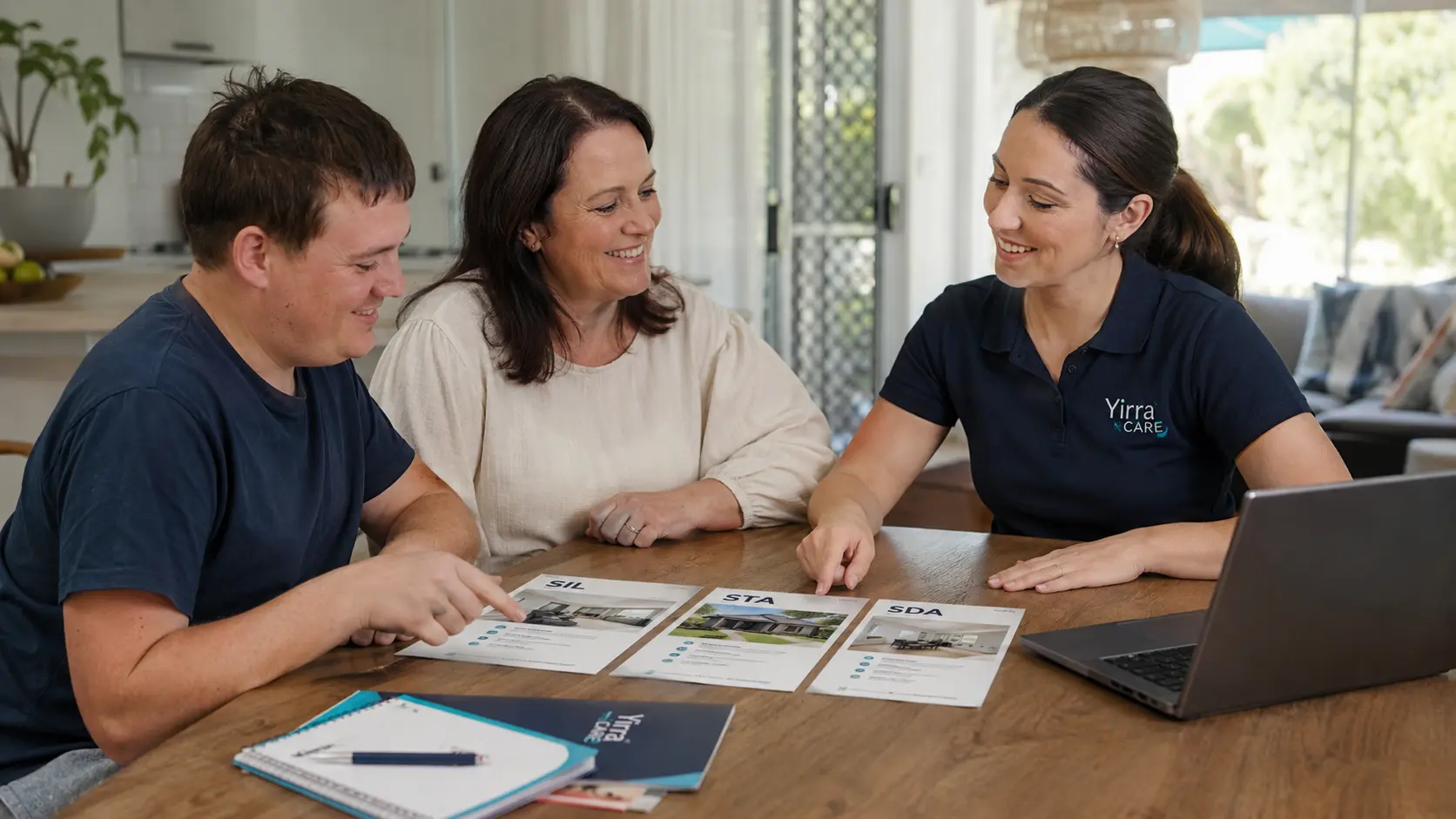
Choosing between ndis housing options can feel confusing because SIL, STA and SDA are often discussed as if they were three different types of houses. They are not.
Supported Independent Living (SIL) is primarily funding for support workers. Specialist Disability Accommodation (SDA) is specialised housing for eligible participants. Short-Term Accommodation (STA), meanwhile, provides temporary accommodation and disability-related support in particular circumstances.
Understanding that distinction can make housing decisions much clearer.
This guide compares SIL, STA and SDA, explains what each option may cover, and shows how participants and families can think about the next step. It also covers other home and living supports that may be relevant, including Medium-Term Accommodation (MTA).
Importantly, NDIS home and living supports are individual. Funding depends on a participant’s disability-related needs, goals, circumstances and the current NDIS funding criteria.
What Do NDIS Housing Options Actually Cover?
The phrase ndis housing options is useful for searching, but it can also create a misunderstanding.
The NDIS does not simply offer a list of houses that participants choose from.
Instead, home and living arrangements may involve different combinations of:
- the home itself
- disability support inside the home
- temporary accommodation
- home modifications
- specialist housing
- informal support
- mainstream or community housing.
Current NDIS guidance makes one distinction especially clear: apart from SDA, the NDIS does not generally fund ordinary housing itself. Most participants own, rent or access housing through other systems. Disability supports may then be funded around that living arrangement.
Support versus accommodation: the key distinction
A simple way to understand the three main terms is:
| Option | What it primarily provides | Typical purpose |
|---|---|---|
| SIL | Support workers and daily assistance | Ongoing support to live more independently |
| STA | Temporary accommodation plus eligible disability-related support | A temporary break from usual care arrangements |
| SDA | Specially designed or modified housing | Housing for eligible participants with very high support needs or extreme functional impairment |
This distinction matters because somebody can potentially receive SIL without living in SDA.
Likewise, a person may live in SDA and receive SIL or another type of support inside the property.
STA serves a different purpose again because it is temporary rather than a long-term housing solution.
For a broader Brisbane-focused overview, Yirra Care’s NDIS housing in Brisbane guide provides additional local context.
Need help understanding which type of support fits your situation? Discuss Home and Living Support Options
Supported Independent Living: Ongoing Support at Home
Supported Independent Living, or SIL, is frequently mistaken for a type of accommodation.
However, current NDIS guidance defines SIL as funding for support workers who help or supervise a participant with day-to-day activities in their home. The aim is to support independence while helping the participant build skills.
Therefore, the most useful question is not:
“Do I need a SIL house?”
Instead, ask:
“How much disability-related support do I need to live safely and as independently as possible?”
What can SIL support with?
Depending on the participant’s needs and approved funding, support workers may assist with activities such as:
- showering and personal care
- dressing
- preparing and eating meals
- household tasks
- cleaning
- daily routines
- developing practical living skills
- attending appointments
- social skills and greater independence.
Current NDIS guidance describes SIL as a support for people with high support needs who require assistance or supervision throughout the day.
That makes SIL different from occasional drop-in support.
What SIL does not pay for
SIL is not funding for the house itself.
It also cannot normally be used for ordinary living expenses such as:
- rent
- groceries
- electricity
- internet
- other everyday household costs.
The NDIS specifically states that SIL cannot be used for rent or ordinary expenses such as groceries.
This distinction is essential when families compare ndis housing options because accommodation and support costs may need to be planned separately.
Can SIL be provided in different homes?
Yes.
A participant may potentially receive SIL while:
- living with other NDIS participants
- living alone
- living in a property that also qualifies as SDA.
The appropriate arrangement depends on the person’s disability-related support needs and approved plan.
Participants exploring this option can review Yirra Care’s Supported Independent Living in Brisbane information for additional local guidance.
Short-Term Accommodation: Temporary Support and Respite
Short-Term Accommodation, or STA, is different from long-term housing options.
It provides temporary time away from a participant’s usual care arrangement while maintaining the disability-related support they need.
Current NDIS guidance says STA can support participants while the people who usually provide significant informal care take a short break.
A useful 2026 update about the name STA
There has been considerable terminology confusion around this support.
In October 2025, the NDIA announced that Short-Term Accommodation would be called Short-Term Respite.
However, in 2026 the terminology changed again.
NDIS updates published in July 2026 confirmed that the term Short-Term Accommodation (STA) had been reinstated following community feedback.
Therefore, STA is the appropriate current terminology for this article.
This is also why families may still encounter websites, plans or older information using “short-term respite”. The terms have changed over time.
What can STA currently be used for?
According to current NDIS guidance, STA funding may be used for eligible disability-related supports such as:
- assistance with showering
- cooking support
- toileting support
- standard temporary accommodation
- overnight support where relevant
- support within an individual or shared accommodation arrangement.
Current guidance generally allows eligible participants to use STA flexibly for up to 28 days per year, including blocks of up to 14 days at a time. Actual funding remains dependent on the individual plan and circumstances.
STA is not a holiday budget
Another important 2026 distinction concerns what STA cannot fund.
Current NDIS guidance excludes expenses such as:
- holiday packages
- holiday accommodation
- airfares
- passports or visas
- entertainment tickets
- travel expenses for family members
- food and meals.
The July 2026 NDIS update specifically reinforced that STA funding cannot be used for holiday packages, holiday accommodation, airfares, food or meals.
That is important because older online explanations of STA may describe broader inclusions that no longer reflect current guidance.
STA should therefore be understood as disability-related temporary support, not funded tourism.
Families considering temporary support can also review Yirra Care’s NDIS Short-Term Accommodation in Brisbane information.
Looking at temporary or ongoing home and living support? Discuss Your Home and Living Goals
Specialist Disability Accommodation: When the Home Itself Is the Support
SDA is fundamentally different from SIL.
Specialist Disability Accommodation refers to the housing itself.
Current NDIS guidance describes SDA as housing for people with extreme functional impairment or very high support needs when other home and living supports may not adequately meet their disability-related needs.
An SDA property may include specialised design features such as:
- wider doorways
- wheelchair-accessible kitchens
- ceiling hoists
- home automation
- accessible bathrooms
- reinforced construction
- backup power
- communication technology.
These design elements allow the home itself to reduce barriers and support greater independence or safety.
What are the SDA design categories?
Current NDIS information identifies four main SDA design categories:
Improved Liveability
Homes with enhanced physical access and features that may assist people with sensory, intellectual or cognitive impairments.
Fully Accessible
Housing designed with significant physical accessibility features, including for participants who use wheelchairs in the home.
Robust
Highly durable housing designed to improve safety and reduce the risk of damage where this relates to a participant’s disability needs.
High Physical Support
Housing with extensive physical-access features for people who need very high levels of support. This can include ceiling hoists, backup power and home automation.
Eligibility for SDA is not automatic because someone has a disability or needs support at home.
The NDIA must determine that SDA meets the participant’s needs and NDIS funding criteria.
Does SDA include support workers?
No.
This is one of the most important points in sil sta sda explained comparisons.
SDA funding relates to the specialised property. It does not include personal care, SIL, ILO or other disability support delivered inside that home.
Can someone have both SIL and SDA?
Yes, where both supports are approved.
A participant may have:
- SDA funding for the specialised dwelling
- SIL funding for support workers inside the dwelling.
Current NDIS guidance specifically notes that many SDA residents also have in-home support funding such as SIL.
This explains why the two terms are often mentioned together.
However, they solve different problems.
SDA = where an eligible participant lives.
SIL = support workers helping the participant live there.
For a more detailed breakdown, see Yirra Care’s difference between SIL and SDA guide.
Does SDA mean the NDIS pays every housing cost?
No.
Participants living in SDA still pay a reasonable rent contribution and ordinary day-to-day expenses such as electricity.
Current NDIS guidance also requires a written service agreement between the participant and SDA provider.
NDIS Housing Options: How Do SIL, STA and SDA Compare?
The easiest way to compare ndis housing options is to start with the problem the participant is trying to solve.
| Question | SIL | STA | SDA |
|---|---|---|---|
| Is it mainly a home or a support? | Support | Temporary accommodation/support | Specialist housing |
| Is it designed for ongoing use? | Yes, where approved | No | Yes |
| Does it fund support workers? | Yes | Eligible temporary support may be included | No |
| Does it fund ordinary rent? | No | Temporary accommodation may be included within eligible STA use | SDA funding covers the specialist housing component, while the participant still pays a reasonable rent contribution |
| Can it involve shared living? | Yes | Yes | Yes |
| Can someone live alone? | Potentially, depending on needs | Potentially | Potentially |
| Main purpose | Daily support and independence | Temporary time away from usual care arrangements | Specialised housing design |
| Can it work with SIL? | SIL is the support | Separate temporary support | Yes |
H3: ndis housing options — which one might fit which situation?
Consider three simplified examples.
Situation 1: Ongoing daily support is the main need
A participant can live in an ordinary rental but needs significant assistance with personal care, meals and daily routines.
SIL may be worth exploring.
The key issue is support, not a specially designed property.
Situation 2: The participant usually lives with significant informal support
A family member provides substantial ongoing disability-related assistance and needs occasional time away from the caring role.
STA may be relevant, subject to the participant’s plan and current eligibility requirements.
Situation 3: The design of an ordinary home cannot adequately meet disability needs
A participant requires specialised accessibility, safety or physical-support features.
SDA may be considered if they meet the relevant criteria.
These examples are not eligibility decisions. They simply show how the purpose of each support differs.
What about MTA?
SIL, STA and SDA are not the only home and living supports.
Medium-Term Accommodation, or MTA, may provide temporary housing for up to 90 days in specific circumstances.
For example, MTA may be considered when a participant has a long-term home identified but cannot move in yet. That could occur while an SDA vacancy becomes available or while essential home modifications are completed.
MTA is not emergency accommodation and does not include ordinary living costs such as food, internet or electricity. Personal care supports are also funded separately where applicable.
What about Individualised Living Options?
Individualised Living Options, or ILO, can provide another way to organise support around how and where a participant chooses to live.
Like SIL, ILO relates primarily to support arrangements rather than purchasing a house.
Therefore, families should avoid assuming that every home and living goal requires SIL or SDA.
The right solution may involve a different combination of mainstream housing, informal supports and NDIS-funded disability supports.
Questions to Ask Before Choosing a Housing or Support Arrangement
Finding the right property is only part of the decision.
A good housing arrangement should also support the participant’s safety, independence, preferences, relationships and long-term goals.
How much support is actually needed?
Consider what happens throughout a normal day.
Does the participant need:
- occasional prompts?
- scheduled support visits?
- significant help with personal care?
- active assistance for much of the day?
- overnight supervision?
- accessible design features?
- continuous access to support?
The answer helps separate a housing issue from a support issue.
Where does the participant want to live?
Choice of location can affect:
- connection with family
- community participation
- transport
- healthcare access
- employment or study
- friendships
- cultural connections.
A technically suitable property may still be a poor long-term choice if it disconnects someone from the life they want.
Who does the participant want to live with?
Shared living should not be treated only as an efficiency decision.
Consider:
- compatibility
- age and lifestyle
- routines
- communication
- privacy
- visitors
- shared spaces
- noise
- pets
- household expectations.
Housing should support choice and control rather than simply place people together because they use similar services.
Are the housing provider and support provider the same?
This question is especially important in SDA and supported living arrangements.
Participants should understand:
- who controls the property
- who provides daily support
- what service agreements apply
- what happens if they want to change support providers
- what happens if they want to move.
Housing Hub also emphasises the distinction between SIL funding and the property itself. SIL pays for support workers rather than creating a particular type of “SIL house”.
What costs remain the participant’s responsibility?
Before agreeing to an arrangement, clarify responsibility for:
- rent
- utilities
- groceries
- internet
- furniture
- transport
- household expenses
- support costs.
Do not assume that NDIS housing-related funding means ordinary living expenses are covered.
What evidence or assessments may be needed?
Some home and living supports can require evidence showing why the support is reasonable and necessary for the participant’s disability-related needs.
Depending on the request, this may involve information from:
- treating professionals
- occupational therapists
- support coordinators
- current providers
- the participant and family.
The NDIA determines what it will fund.
A provider should therefore help participants understand support options without promising that a particular housing arrangement will receive funding.
Ready to explore the next step without assuming which option is right? Start a Home and Living Support Enquiry
FAQs About NDIS Housing Options
What are the main NDIS housing options?
Common home and living supports include SIL, SDA, STA, MTA, ILO, personal care supports and home modifications. However, these do not all fund housing itself. SDA specifically relates to specialist housing, while several other options fund disability support or temporary arrangements.
What is the main difference between SIL and SDA?
SIL funds support workers who help with daily life. SDA funds specialised housing for eligible participants with extreme functional impairment or very high support needs. A participant may potentially have both.
What is the difference between SIL and STA?
SIL is designed for ongoing support at home for people with high support needs. STA is temporary and provides time apart from usual care arrangements while maintaining eligible disability-related support.
Is STA still called Short-Term Respite?
The current term is Short-Term Accommodation (STA). The NDIA renamed it Short-Term Respite in October 2025 but changed the terminology back to Short-Term Accommodation in 2026 following community feedback.
Can the NDIS pay my rent?
Generally, ordinary rent and everyday housing expenses are not NDIS-funded supports. SIL cannot pay rent. SDA funding relates to specialist accommodation, but participants still pay a reasonable rent contribution and ordinary living expenses.
Can I have SIL and SDA together?
Yes, if both are appropriate and included in the participant’s plan. SDA pays for the specialised housing component, while SIL can fund support workers providing assistance inside the home.
Is STA a way to fund a holiday?
No. Current NDIS guidance states that STA cannot be used for holiday packages, holiday accommodation, airfares, food, meals and various recreational or travel expenses.
What is MTA compared with STA?
MTA is temporary accommodation for specific transition situations, potentially for up to 90 days. For example, it may apply while a participant waits for a long-term home to become available. STA has a different purpose and primarily provides temporary time apart from usual care arrangements.
Understanding ndis housing options becomes much easier once housing and support are separated.
SIL is about ongoing assistance. STA is temporary. SDA is specialist housing. Other supports such as MTA or ILO may also be relevant depending on the participant’s circumstances.
The best starting point is therefore not choosing an acronym.
Start with the participant’s disability-related needs, desired living arrangement, support requirements and long-term goals. Then identify which combination of housing and support may fit those needs.
For participants and families in Brisbane, Yirra Care can discuss home and living support options and help identify appropriate next steps without guaranteeing NDIS eligibility or funding.
Want to discuss your home and living support goals? Talk to Yirra Care About Housing Support