Improved Daily Living NDIS Brisbane vs Daily Living Support: What’s the Difference?
Searching for Improved Daily Living NDIS Brisbane support can become confusing because the NDIS also uses terms such as Assistance with Daily Life, Daily Personal Activities and daily living skills.
They sound similar, but they do not mean the same thing.
The simplest distinction is this:
Assistance with Daily Life helps a participant complete everyday tasks now.
Improved Daily Living is Capacity Building funding designed to help a participant build skills, functional capacity and independence over time.
Current NDIS guidance places Assistance with Daily Life within Core Supports and gives examples such as cleaning, cooking and personal care. Improved Daily Living sits within Capacity Building and can fund supports that build living skills and independence, including assessments, training and therapies such as occupational therapy or speech therapy.
Understanding that distinction matters when reading an NDIS plan, choosing providers and deciding which type of support to enquire about.
What Is Assistance With Daily Life Under the NDIS?
Assistance with Daily Life is a Core Support.
It may be included when a participant needs disability-related help with everyday tasks and activities.
Current NDIS examples include:
- cleaning
- cooking
- personal care
- yard maintenance
- other everyday tasks.
The purpose is practical assistance.
A support worker may be helping the participant complete something that needs to happen as part of daily life.
What NDIS daily living support Brisbane can look like
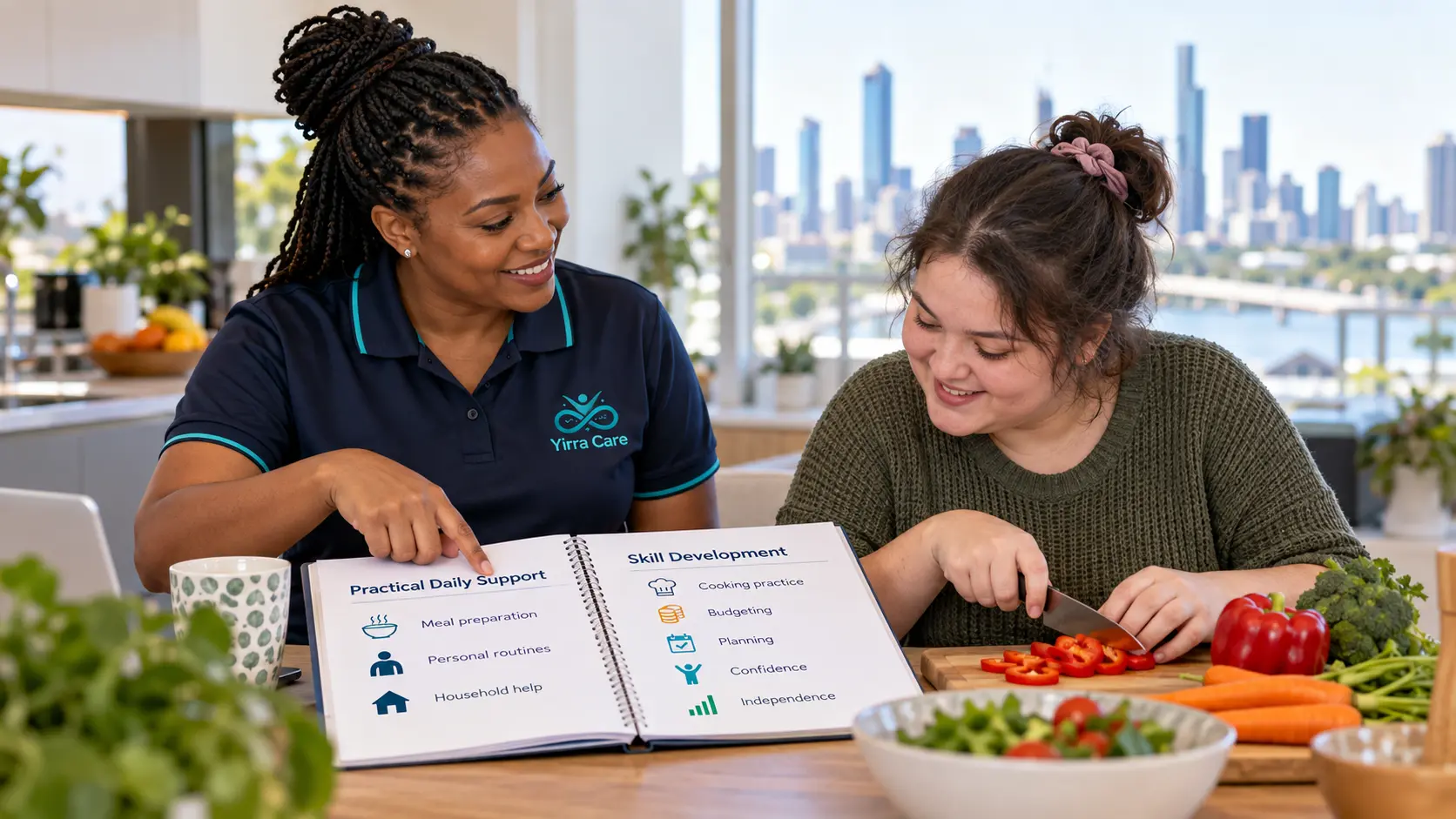
For example, a participant might receive support with:
- getting organised in the morning
- preparing breakfast
- meal preparation
- laundry
- household routines
- getting ready for appointments
- personal care
- planning the day.
The exact support depends on the participant’s plan, disability-related needs and individual circumstances.
For practical examples, see Yirra Care’s NDIS Assistance with Daily Life Brisbane guide.
What Is Improved Daily Living NDIS Brisbane?
Improved Daily Living NDIS Brisbane refers to a Capacity Building support category.
Capacity Building funding is designed to help participants develop skills, increase independence and work towards their goals.
Official NDIS guidance describes Improved Daily Living as funding for supports that help build living skills and increase independence and involvement in the community.
Examples may include:
- assessments
- training
- occupational therapy
- speech therapy
- other appropriate capacity-building or therapeutic supports included in the participant’s plan.
The purpose is therefore different from someone simply helping complete a daily task.
Improved Daily Living focuses on building capacity
A useful way to think about it is:
Assistance: someone helps you do the task.
Capacity building: an appropriate professional or training support helps you develop abilities or strategies related to the task.
That distinction is not always perfectly simple in real life, but it helps explain why the NDIS places these supports in different budgets.
Daily Living Support vs Improved Daily Living NDIS
Here is the practical difference.
| Question | Assistance with Daily Life | Improved Daily Living |
|---|---|---|
| Budget type | Core Supports | Capacity Building |
| Main purpose | Help with everyday activities | Build skills, capacity and independence |
| Typical focus | Completing daily tasks | Assessment, training, therapy or skill development |
| Examples | Cooking assistance, cleaning, personal care | OT, speech therapy, assessments, structured capacity building |
| Time focus | Practical support needed now | Developing abilities over time |
| Funding flexibility | Core can often be flexible within applicable rules | Capacity Building categories are stated |
| Yirra Care connection | Relevant to Yirra Care’s current In-Home Support service | Not presented as a standalone Yirra Care service category on the current In-Home Support page |
Current NDIS guidance states that Capacity Building categories are stated, meaning funding cannot simply be moved from one Capacity Building category to another. Core Supports have greater flexibility, subject to the participant’s plan and applicable NDIS rules.
Practical Example: Cooking Dinner
Cooking is a good example because the same everyday activity can involve different types of support.
Assistance with Daily Life
A participant has difficulty preparing dinner because of disability.
A support worker might:
- prepare ingredients
- help cook the meal
- complete parts the participant cannot manage
- clean the kitchen afterwards.
The immediate goal is to get the everyday task completed.
Capacity building
Another participant wants to become more independent preparing meals.
An appropriate capacity-building support might focus on:
- assessing functional barriers
- adapting the task
- developing safer techniques
- establishing a repeatable routine
- learning specific skills.
The emphasis is on developing capability.
Carevo describes a similar distinction in its current life-skills guidance: daily assistance may involve a worker helping complete the task, while structured life-skills development aims to increase what the participant can do independently over time.
Practical Example: Getting Dressed
The same distinction can apply to personal routines.
Daily living assistance
A participant may require physical help putting on clothes each morning.
That is practical support with an immediate daily activity.
Improved Daily Living
An occupational therapist might instead assess:
- movement
- coordination
- task sequencing
- the home environment
- assistive strategies.
They may recommend ways to make dressing easier or help the participant develop functional skills.
The professional assessment and skill-building purpose is different from a support worker providing regular assistance with dressing.
Practical Example: Communication
A participant may need a support worker to help them navigate communication during everyday activities.
That is different from speech therapy designed to develop communication skills.
The NDIS specifically identifies speech therapy as an example of support that may be funded through Improved Daily Living.
Again, the difference is not the broad goal of “greater independence”.
It is the purpose and type of support being delivered.
Does Improved Daily Living Mean Life Skills Training?
It can include skill development, but the category is broader than basic support-worker life-skills coaching.
Official NDIS guidance describes Improved Daily Living as including assessments, training or therapies that help build living skills and independence.
Providers in the market use the phrase differently.
Janalli Services, for example, describes Improved Daily Living Skills as capacity-building support around routines, communication, confidence, decision-making and independence, and also delivers therapeutic services connected with this funding category.
The Way Forward in Brisbane specifically uses Improved Daily Living funding for capacity-building social work services.
Nexus Care Services similarly presents Improved Daily Living as a Capacity Building category focused on increasing independence and skills.
This variation is why participants should check:
- the exact support in their plan
- the provider’s qualifications or registration where relevant
- what the service is actually intended to achieve
- which budget the provider intends to claim from.
Improved Daily Living Skills NDIS Is Not the Same as Personal Care
This is an important distinction.
Personal care may involve assistance with:
- showering
- dressing
- grooming
- toileting
- other personal routines.
These everyday support needs may sit within Assistance with Daily Life where appropriate to the participant’s plan.
Improved Daily Living is not simply another name for personal care.
The official NDIS Core Supports page specifically identifies personal care as an example of Assistance with Daily Life.
A participant may potentially have both kinds of support in their plan, but they serve different purposes.
Can a Participant Have Both?
Yes, depending on their individual NDIS plan.
For example, someone might receive practical Assistance with Daily Life while also receiving occupational therapy through Capacity Building.
The two supports could work around the same broader goal while performing very different roles.
Example
A participant wants greater independence in the kitchen.
Support worker: helps prepare meals safely during the week.
Occupational therapist: assesses functional barriers and recommends strategies or adaptations to increase independence.
Both may contribute to the participant’s daily life, but they are not interchangeable services.
NDIS plans are individual, and participants only receive funding in the budgets and categories considered relevant to their needs.
Can You Move Core Funding Into Improved Daily Living?
Do not assume so.
Current NDIS guidance says Capacity Building funding categories are stated. Funding allocated to one Capacity Building category cannot simply be shifted into another category.
Core funding has more flexibility across relevant Core categories, but it still cannot simply be converted into a different support budget such as Capacity Building.
If you are unsure what a budget can purchase, check the current plan or speak with the appropriate NDIS contact, plan manager or support coordinator.
Important Changes to Improved Daily Living From 1 October 2026
This article is scheduled for publication on 27 October 2026, after an important NDIS funding change began.
The NDIA announced that budgets for two support categories are being progressively reduced:
- Social, Economic and Community Participation
- Improved Daily Living Skills.
The changes apply as plans are:
- created or reassessed from 1 October 2026
- renewed from 1 February 2027.
This does not mean everyone’s budget changed on 1 October
The reductions are being introduced progressively.
The NDIA states that the effect will differ for every participant because NDIS plans are based on individual goals, circumstances and support needs.
Participants should therefore check their own current plan rather than assuming a general percentage or reduction applies to them.
Some supports are not affected by these reductions
The NDIA has stated that some support groups within the affected categories are excluded, including certain:
- employment supports
- disability-related health supports
- high-intensity supports
- intensive and complex behaviour supports.
It has also clarified that essential day-to-day supports such as help with eating, dressing, toileting, laundry and cleaning are among supports not affected by this specific change.
This further illustrates why Improved Daily Living Skills and everyday Core Assistance with Daily Life should not be treated as the same budget.
Which Type of Support Do You Actually Need?
Start with the problem rather than the category name.
“I need someone to help me prepare dinner three nights each week.”
That sounds more like a practical Assistance with Daily Life question.
“I want to learn strategies so I can prepare meals more independently.”
That may involve capacity-building assessment, therapy or structured skill development depending on the person’s plan.
“I need help showering and dressing every morning.”
That is primarily a practical daily personal support question.
“I want an OT to assess why dressing is difficult and recommend strategies.”
That is a different support purpose and may relate to Improved Daily Living.
“I need help keeping my household routine organised.”
That may be Assistance with Daily Life.
“I need professional assessment and strategies to improve my functional independence.”
That may point towards Capacity Building.
These examples are general only.
The participant’s individual plan determines what funding is available.
Where Yirra Care Fits
Yirra Care’s current NDIS In-Home Support Brisbane service focuses on practical assistance with:
- daily routines
- meal-related tasks
- planning
- home organisation
- preparing for community activities
- personal support discussions
- confidence and independence at home.
The current service page does not present Improved Daily Living as a standalone therapy or Capacity Building service.
That distinction should remain clear.
Yirra Care should therefore not tell a participant:
“We provide Improved Daily Living”
simply because the participant wants to become more independent.
The correct question is what type of support the participant actually needs.
When Yirra Care’s In-Home Support may be relevant
If the need is practical help with everyday routines or Assistance with Daily Life, Yirra Care may be able to discuss suitable in-home support.
Discuss Assistance With Daily Life Support
If the need is specifically for an Improved Daily Living assessment, therapy or Capacity Building service that Yirra Care does not provide, the participant should identify an appropriately qualified provider for that support.
Questions to Ask Before Choosing a Daily Living Provider
Whether the enquiry concerns practical daily support or Capacity Building, ask the provider:
Which NDIS category are you proposing to use?
Do not rely only on the service name.
Ask what budget and support category the service relates to.
Is the support assistance or skill development?
Ask:
Will someone be helping me complete this task, or is the purpose to assess, train or build my ability to do it?
Who delivers the service?
Depending on the support, this could involve:
- disability support workers
- occupational therapists
- speech pathologists
- other appropriately qualified professionals.
What outcome is the service trying to achieve?
A provider should be able to explain this clearly.
Does my current plan include funding for it?
Do not assume that having Capacity Building funding generally means every Improved Daily Living support can be purchased.
Capacity Building support categories are stated.
How will progress be reviewed?
For capacity-building supports, ask how goals, progress or outcomes will be monitored.
Common Mistakes When Reading Daily Living Funding
Mistake 1: Thinking all “daily living” supports come from the same budget
They do not.
Core Assistance with Daily Life and Capacity Building Improved Daily Living are different.
Mistake 2: Assuming Improved Daily Living means a support worker completing household tasks
That is generally not the purpose of the category.
Mistake 3: Assuming anything that increases independence is Improved Daily Living
Many NDIS supports can contribute to independence.
The category depends on what support is being delivered and its purpose.
Mistake 4: Assuming one provider must deliver both
Participants may use different providers for practical assistance and therapeutic or Capacity Building supports.
Mistake 5: Relying on old budget information
From October 2026, some Improved Daily Living Skills budgets are changing progressively.
Always use the participant’s current plan.
FAQs About Improved Daily Living NDIS Brisbane
What is Improved Daily Living NDIS Brisbane?
Improved Daily Living NDIS Brisbane refers to Capacity Building supports designed to build living skills, independence and community involvement. The NDIS gives examples including assessments, training, occupational therapy and speech therapy.
Is Improved Daily Living the same as Assistance with Daily Life?
No. Assistance with Daily Life is a Core Support focused on practical everyday assistance. Improved Daily Living sits within Capacity Building and focuses on developing skills and functional capacity.
Is personal care Improved Daily Living?
Personal care is specifically identified by the NDIS as an example of Assistance with Daily Life under Core Supports.
Can Improved Daily Living include occupational therapy?
Yes. The NDIS specifically lists occupational therapy to build functional skills as an example of Improved Daily Living.
Can Improved Daily Living include speech therapy?
It can. The official NDIS Capacity Building guidance lists speech therapy to support communication as an example.
Can I move unused Core funding into Improved Daily Living?
Not simply because money remains available. Core and Capacity Building are different support budgets, and Capacity Building categories are stated. Funding use must follow the participant’s plan and applicable NDIS rules.
Did Improved Daily Living funding change in October 2026?
Yes. Budget reductions for some Improved Daily Living Skills supports began being applied progressively to new or reassessed plans from 1 October 2026, with renewed plans transitioning from 1 February 2027. The individual impact varies.
Does Yirra Care provide Improved Daily Living therapy?
Yirra Care’s current public In-Home Support service describes practical daily living assistance, routines, meal-related tasks, planning and personal support discussions. It does not currently present Improved Daily Living therapy as a standalone service.
When should I contact Yirra Care?
If the participant is looking for practical in-home assistance with daily routines or Assistance with Daily Life, Yirra Care can discuss the support request and determine suitability.
Understand the Purpose Before Choosing the Provider
The difference between Improved Daily Living NDIS Brisbane and everyday daily living support comes down largely to purpose.
If someone needs practical assistance to complete everyday tasks, they may be looking at Assistance with Daily Life.
If they need assessment, training or therapy intended to build skills and functional independence, they may be looking at Improved Daily Living within Capacity Building.
A participant may have both.
But one should not be presented as the other.
Before arranging support, check the participant’s current plan, identify the actual need and make sure the provider is offering the correct type of service.
For practical everyday support, Yirra Care’s NDIS Daily Living Support guide explains how Assistance with Daily Life may work.
If the need is practical support at home: